

How many citations are needed to get the EB-1 Green Card
How many citations are needed to get the EB-1 Green Card?
There is no official minimum citation count for an EB-1 Green Card.
How many citations are needed to get the EB-1 Green Card?
There is no official minimum citation count for an EB-1 Green Card. However, based on 2025–2026 adjudication trends, we observed that 50–100 citations are generally considered a 'solid' profile, while 200+ is considered 'strong.' Success ultimately depends on your field's norms and the 'Final Merits Determination' by USCIS.
Table of Contents:
a) What is the exact citation number needed for EB-1A? #️
b) Explaining dependent versus independent citations for EB-1A 🤝
c) The USCIS standard for EB-1 eligibility 🔍
d) The Kazarian factor: why the total citation isn’t everything?
What is the Exact Citation Number Required for EB-1A?
Achieving the EB-1 visa is a pinnacle for international researchers, but meeting the stringent EB-1 visa requirements demands more than just a high citation count. To secure an EB-1 green card, you must prove your "extraordinary ability" or "outstanding" status through specific EB-1 criteria. A common question for applicants is: how many citations EB1 adjudicators actually expect? While USCIS has no official minimum, quality and field-specific benchmarks—often ranging from 50 to over 300—are critical to demonstrating the "major significance" of your original contributions.
| Field of Research | High Impact (Strong) | Moderate (Solid) | Developing (Risky) |
|---|---|---|---|
| Biomedical / Life Sciences | 300+ Citations | 100 – 250 | < 50 Citations |
| Engineering / AI & Tech | 200+ Citations | 80 – 200 | < 40 Citations |
| Physical Sciences / Chemistry | 150+ Citations | 50 – 150 | < 30 Citations |
| Mathematics / Social Sciences | 50+ Citations | 20 – 50 | < 10 Citations |
Let’s go into more detail: to know “how many citations for eb1” is enough, you should know that the determination of eligibility for the EB-1 green card category is contingent upon the specific category for which an application is submitted (EB-1A or EB-1B), in addition to the criteria that the applicant fulfills. However, in the case of the Extraordinary Ability and the Distinguished Researcher or Professor categories, the presence of greater citation numbers is advantageous for the EB-1 visa/green card.

What is the difference between dependent versus independent citations for EB-1A?
Before discussing the exact citation numbers needed for the EB-1A and EB-B categories, an important definition should be explained: dependent citation. This distinction is critical for USCIS adjudicators because it separates local reputation from international impact.
Dependent citations occur when your work is cited by:
a) Yourself (self-citations).
b) Your co-authors, supervisors, or immediate colleagues.
c) Researchers within your own institution.
While these count towards your total, USCIS views them with scrutiny. They are often perceived as biased or "internal" praise rather than objective proof of your influence. Independent citations come from researchers who have never worked with you, do not know you personally, and are often based at other institutions or in other countries. These are the "gold standard" for EB-1A and EB-1B petitions.
USCIS officers look for independent citations to prove that your work has been utilized by the wider scientific community, not just your close circle. A high number of independent citations acts as objective evidence that your "original contributions" have triggered a sustained national or international trend. If 90% of your citations are dependent, USCIS may argue your impact is limited to your personal network, potentially leading to a denial.
The USCIS Standard for EB-1 Eligibility
When evaluating whether a researcher meets the "extraordinary ability" threshold, the government follows specific employment-based immigration first preference EB-1 guidelines. To succeed, an applicant must demonstrate that they are among the small percentage who have risen to the very top of their field of endeavor. Citations serve as primary evidence for two of the ten regulatory criteria: "original scientific or scholarly contributions of major significance" and the "authorship of scholarly articles." However, simply meeting the 3-criteria minimum is rarely enough; the "Kazarian" standard requires a final merits determination where the quality and international reach of your citation record prove a level of expertise that sets you apart from your peers.
What are USCIS Academic Standards for EB-1 Petitions?
The significance of a citation is often measured by its context within the broader scientific community. According to academic standards for EB-1 petitions, a high citation count acts as objective evidence that your work has been acknowledged by other experts in the field. This impact is further validated through bibliometric analysis, where researchers use tools like the h-index and citation tracking to quantify the visibility and durability of their contributions. To capture the attention of a USCIS officer, it is not just the number that matters, but the "quality" of the citing works—specifically those published in high-impact journals or those that characterize your findings as a "breakthrough" or "foundational" to subsequent research.
How many citations for EB-1?
While there's no fixed numerical answer to how many citations for EB-1 or how many citations for EB1 green card are explicitly required by USCIS, citations are a crucial component, especially for the EB-1A (Extraordinary Ability) and EB-1B (Outstanding Professors and Researchers) categories. For EB-1A, the USCIS evaluates each case individually, but generally, a significant number of citations, often 100 or more, can greatly strengthen your application, though approvals with fewer than 50, or even 8 citations for an EB1B, are also documented, particularly when coupled with other strong evidence. The citations required for EB1 success are not just about quantity; the quality and impact of those citations, such as being cited in prestigious journals or by leading experts, hold significant weight. To effectively receive a citation boost and increase your chances, focus on publishing high-quality, impactful research, optimizing your work for discoverability, and promoting it actively within your academic community.
If you are looking for solid strategies to increase your independent citations, read this blog.

The Kazarian Factor: Why the Total Citation Isn’t Everything
In 2010, the Kazarian v. USCIS ruling established that an EB-1A petition must undergo a two-step review. This means that simply hitting a "target number" of citations is not a guarantee of success.
Step 1: The "Counting" Phase
The officer checks if you meet at least 3 out of 10 regulatory criteria. If you have 200 citations, you "check the box" for the scholarly articles criterion.
Step 2: The Final Merits Determination
This is where many petitions are denied. Even if you have 500 citations, the officer asks: "Does this evidence collectively show that the applicant has reached the very top of their field?"
In this stage, USCIS evaluates the "Quality" of your citations using these factors:
Independence: Are the citations from researchers you have never worked with? USCIS heavily discounts "self-citations" or citations from your co-authors.
Context of Mention: Are you cited in a "string citation" (where you are just one of 20 names listed), or is your work discussed in detail?
Journal Prestige: Citations from Nature, Science, or Cell carry significantly more weight than citations from predatory or low-tier journals.
Geographic Reach: Are researchers from 20 different countries citing you, or only researchers from your home university? Global spread proves "international acclaim."
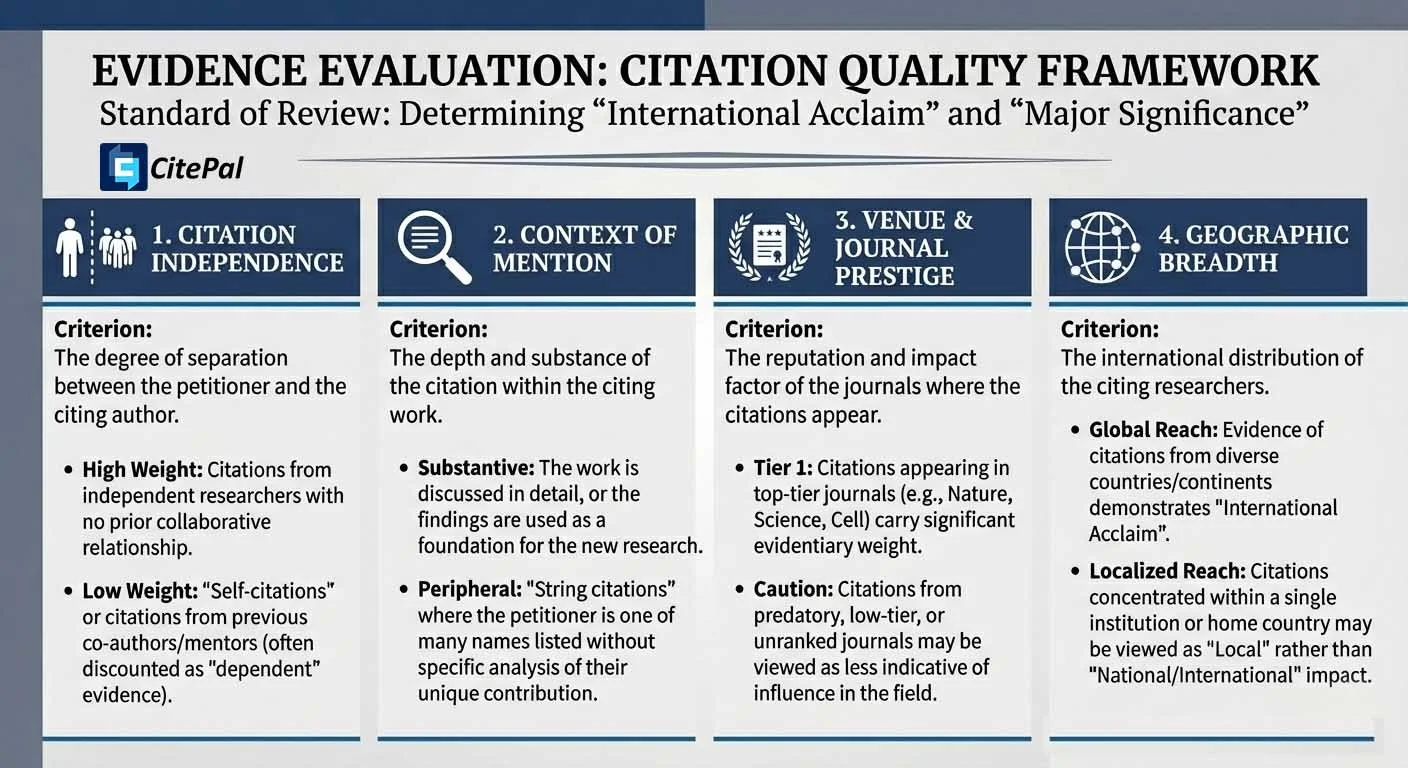
Final Merits Determination With High Citation
These 3 specific strategies can help strengthen the "Final Merits" case:
The "Top 1%" Argument: Use tools like Web of Science or Essential Science Indicators to show that your 100 citations actually put you in the top 1% of your specific sub-field (e.g., "Organic Chemistry in the last 5 years").
Highlighting "Highly Cited" Status: If any of your papers are officially flagged as a "Highly Cited Paper" or "Hot Paper" in your database, dedicate a paragraph to this. It is objective proof of "major significance."
The Narrated Citation List: Instead of just a list of numbers, provide "mini-summaries" of your 5 most important citations. Explain how those researchers used your work to make their own breakthroughs.
Do you want to apply for an EB-1 green card but do not have enough citations? You can use our packages to increase your citations and h-index quickly for the EB-1 visa/green card.
❓ Frequently Asked Questions about High Citation for EB-1 Green Card
Is there a "magic number" of citations required for EB-1 approval?
While USCIS does not set a mandatory minimum, a count of 100 or more citations is generally considered a strong threshold for EB-1A and EB-1B petitions. However, "how many citations for EB-1" is enough depends heavily on your specific field and the quality of your evidence. While some researchers are approved with fewer than 50 citations, others with hundreds may face scrutiny if those citations lack "major significance." The key is demonstrating that your work has influenced the field at large.
Can I include self-citations in my total EB-1 citation count?
You can include them, but USCIS adjudicators typically subtract self-citations and citations by close collaborators to evaluate your true independent impact. Dependent citations (from yourself, your supervisor, or your lab) are often viewed as "internal praise" rather than objective proof of international acclaim. To build a bulletproof case, it is essential to focus on independent citations from researchers who have no personal or professional connection to you.
Can I still qualify for an EB-1 visa if I have fewer than 50 citations?
Yes, it is possible to succeed with a lower citation count if you can prove the extraordinary impact of the citations you do have. For example, being cited by a government agency, featured in a top-tier journal like Nature or Science, or having your work used in a global patent can outweigh a high volume of "routine" citations. Quality and "original contribution of major significance" often speak louder than raw numbers in the eyes of a USCIS officer.
Why is the "Independent Citation" considered the gold standard?
Independent citations serve as objective evidence that your research is being utilized by the global scientific community without any personal bias. Because these citations come from researchers at different institutions or in different countries who have never met you, they prove that your work is driving the field forward on its own merit. This is precisely what USCIS looks for to satisfy the "sustained national or international acclaim" requirement.
How can I quickly increase my citation count for an upcoming petition?
The most effective way is to use targeted visibility strategies, such as publishing review papers, sharing work on preprint servers, and utilizing professional organic boosting services. Because the EB-1 application process is time-sensitive, researchers often need to ensure their work is visible to the right academic circles immediately. CitePal specializes in accelerating this process by providing organic, independent citations that help you reach the necessary thresholds for your green card petition.
Written by the CitePal Editorial Team, specializing in academic metrics and USCIS citation standards for EB-1A, EB-1B, NIW petitions, and citation boosting services. Our data is derived from 500+ successful applicant profiles.