

How Long Does EB1 Green Card Take? Eligibility & Criteria (2026)
United States EB-1 green card:
How long does it take?
Eligibility and rules
[2026 Update]
How Long Does EB1 Green Card Take? Eligibility & Criteria (2026)
On average, an EB-1 green card takes 8 to 18 months for most applicants using premium processing. While the initial I-140 petition can be approved in just 15 business days ($2,965 fee), the total timeline is determined by your country of birth and whether you are applying from within the U.S. (Adjustment of Status) or abroad (Consular Processing). For applicants from 'Rest of World' countries, the process is relatively fast, while those from India and China currently face multi-year backlogs due to visa retrogression. Maximizing your evidence, such as citation counts, is the best way to avoid a Request for Evidence (RFE) that could delay your case by another 6+ months. In this blog, we will discuss the timeline of the EB-1 Green Card and the latest 2026 eligibility and criteria.
Table of Contents:
a) EB-1 processing time breakdown (2026 step-by-step timeline)⌛
b) What is the EB-1 processing time for India and China? 🆕
c) EB-1 Categories: EB-1A | EB-1B | EB-1C 📊
d) Total Number of EB-1 Green Cards per Year #️
e) The Benefits of EB-1 Green Cards 🪪
f) How Citations Help To Get an EB-1 Green Card 💡
g) How many citations are needed for an EB-1 Green Card? 💯
Frequently Asked Questions about EB-1 Eligibility and Rules❓

EB-1 Processing Time Breakdown (2026 Step-by-Step Timeline)
Understanding how long it takes to get an EB-1 green card approval is crucial for applicants. For a detailed breakdown, see this guide on the B-1 green card processing timeline. The process typically involves two main steps: the Immigrant Petition (Form I-140) and the Adjustment of Status (Form I-485) if applying from within the U.S., or Consular Processing if applying from abroad.

The processing time for the Form I-140, the initial petition, can vary significantly depending on the USCIS service center and whether premium processing is utilized. With premium processing, an I-140 decision can be expedited to 15 calendar days for an additional fee. Without premium processing, average processing times for I-140 can range from several months to over a year. Use the official USCIS processing times tool for current data. depending on the specific EB-1 subcategory and service center caseloads. The following table provides a comprehensive estimated timeframe for different EB-1 processes, according to the February 2026 Visa Bulletin.
| EB-1 Process Step | Estimated Timeframe (2026) |
|---|---|
| I-140 Petition (Premium) | 15 to 45 business days (Guaranteed decision with USCIS fee) |
| I-140 Petition (Standard) | 6 to 12 months (Varies by USCIS service center) |
| Priority Dates (Visa Bulletin) | Usually "Current" (Immediate filing available for most countries) |
| I-485 Adjustment of Status | 6 to 12 months (Includes biometrics and interview) |
| Total Estimated Time | 8 to 18 months (Depending on Premium Processing usage) |
What is the EB-1 Processing Time for India and China? 2026 Update
Fees: As of March 1, 2026, the Premium Processing fee for Form I-140 is $2,965. The previous price was $2,805.
Visa Bulletin: Make sure to check the latest September 2026 Visa Bulletin dates from the US Visa Bulletin website. For example, according to the March 2026 Visa Bulletin, as of the writing this text, the priority dates for India and China in the employment-based categories are as follows:
| Category | Final Action Date (China) | Final Action Date (India) | Date for Filing (China) | Date for Filing (India) |
|---|---|---|---|---|
| EB-1 (Priority Workers) | July 1, 2023 | October 15, 2022 | January 1, 2024 | December 1, 2023 |
| EB-2 (Advanced Degrees) | September 1, 2021 | Unavailable (U) | January 1, 2022 | January 15, 2015 |
| EB-3 (Skilled Workers) | January 1, 2022 | January 1, 2014 | July 1, 2022 | January 15, 2015 |
Am I Eligible for EB-1? US Green Card EB-1 Eligibility: Three Main Categories *2025/2026 Update
The US EB-1 visa is a highly sought-after employment-based immigrant visa, often referred to as the "gold standard" for foreign nationals seeking a green card for employment-based immigrants in the United States. It falls under the "First Preference" category, indicating that it is reserved for "priority workers" who demonstrate exceptional abilities or are highly accomplished in their fields. The ultimate goal of this visa is to obtain a US EB-1 green card, which grants individuals the right to live and work permanently in the U.S. without the need for a sponsoring employer in all subcategories, and without the often lengthy PERM labor certification process required for other employment-based green cards.
1) EB-1A: Individuals with Extraordinary Ability
This category is for foreign nationals who possess extraordinary ability in the sciences, arts, education, business, or athletics. To qualify, applicants must demonstrate sustained national or international acclaim, with their achievements recognized in their field through extensive documentation. A significant advantage of the EB-1A is that it allows for "self-petitioning," meaning you do not need a U.S. employer to sponsor your petition. Evidence for this category typically includes:
● Receipt of a major, internationally recognized award (e.g., Nobel Prize, Oscar, Olympic Medal).
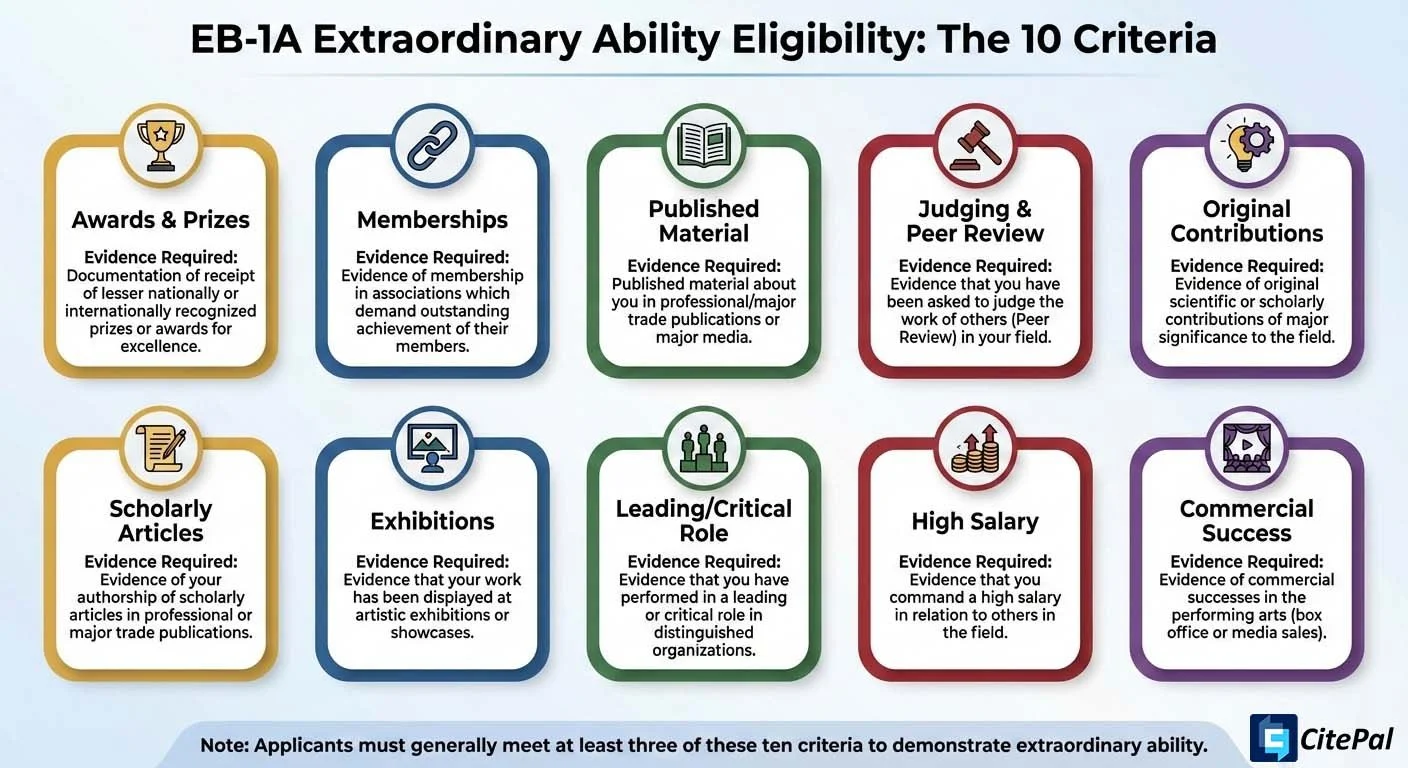
Failing that, applicants must meet at least three of the following ten criteria:
| EB-1A Criterion | Description of Evidence Required |
|---|---|
| 1-Awards & Prizes | Documentation of receipt of lesser nationally or internationally recognized prizes or awards for excellence. |
| 2-Memberships | Evidence of membership in associations which demand outstanding achievement of their members. |
| 3-Published Material | Published material about you in professional/major trade publications or major media. |
| 4-Judging & Peer Review | Evidence that you have been asked to judge the work of others (Peer Review) in your field. |
| 5-Original Contributions | Evidence of original scientific or scholarly contributions of major significance to the field. |
| 6-Scholarly Articles | Evidence of your authorship of scholarly articles in professional or major trade publications. |
| 7-Exhibitions | Evidence that your work has been displayed at artistic exhibitions or showcases. |
| 8-Leading/Critical Role | Evidence that you have performed in a leading or critical role in distinguished organizations. |
| 9-High Salary | Evidence that you command a high salary in relation to others in the field. |
| 10-Commercial Success | Evidence of commercial successes in the performing arts (box office or media sales). |
2) EB-1B: Outstanding Professors and Researchers
This category is for professors and researchers who are internationally recognized as outstanding in a specific academic field. Unlike the EB-1A, EB-1B category generally requires a U.S. employer to file the petition on behalf of the foreign national. The US EB1 visa requirements for this group include:
● International recognition for outstanding achievements in a particular academic field.
● At least three years of experience in teaching or research in that academic area (experience gained while pursuing an advanced degree may count if the degree was received and the teaching/research was recognized as outstanding).
● A job offer for a tenured or tenure-track teaching position or a comparable permanent research position from a U.S. university or institution of higher education, or a private employer with at least three full-time researchers and documented research accomplishments.
Applicants must also meet at least two of the following six criteria:
| EB-1B Criterion | Description of Evidence Required |
|---|---|
| 1-Academic Awards | Evidence of receipt of major prizes or awards for outstanding achievement in the academic field. |
| 2-Association Memberships | Evidence of membership in associations that require their members to demonstrate outstanding achievements. |
| 3-Published Material | Evidence of published material in professional publications written by others about your work in the academic field. |
| 4-Judging & Peer Review | Evidence of participation, either on a panel or individually, as a judge of the work of others in the same or allied academic field. |
| 5-Original Research | Evidence of original scientific or scholarly research contributions in the academic field. |
| 6-Scholarly Books or Articles | Evidence of authorship of scholarly books or articles (in scholarly journals with international circulation) in the academic field. |

3) EB-1C: Multinational Managers or Executives
This category is for multinational executives and managers who are transferred to the U.S. by their foreign employer. The employer must have a qualifying relationship (parent, subsidiary, affiliate) with the U.S. entity and must intend to employ the individual in a managerial or executive capacity. The applicant must have been employed outside the U.S. for at least one year in the preceding three years by the qualifying organization in a managerial or executive capacity.

Total number of EB-1 green cards per year
The U.S. immigration system allocates approximately 140,000 employment-based immigrant visas annually, with the EB-1 category receiving roughly 40,040 of these visas, plus any unused visas from lower preference categories. While this allocation generally keeps the EB-1 category current for most countries, high-demand countries like India and China may experience "retrogression," leading to longer wait times for their nationals. In summary, the US EB-1 green card offers a direct and often faster path to permanent residency for individuals who have demonstrated extraordinary ability or exceptional accomplishments in their fields. Meeting the specific US green card EB1 eligibility criteria and navigating the application process efficiently are key to securing this highly desirable immigrant visa.

What are the benefits of the EB-1 green cards?
The EB-1 Employment-Based Green Card offers permanent residency in the United States to individuals who can demonstrate that they have extraordinary ability in the arts, athletics, business, education or the sciences; outstanding researchers and professors with international recognition in a specific field; or certain multinational executives or managers.
Certain types of evidence must be provided for an applicant to prove that he or she has extraordinary ability or is an outstanding researcher or professor. Examples may include major awards for achievement, citations in professional or scholarly publications, etc.
If approved for an EB-1 Employment-Based Green Card, a skilled foreign worker and his or her spouse and unmarried dependent children under 21 years of age can enjoy many benefits such as:
| Benefit | Description & Strategic Advantage |
|---|---|
| No Labor Certification (PERM) | Unlike EB-2 or EB-3, you skip the Department of Labor (PERM) process, saving 6–12 months of waiting time and significant costs. |
| Self-Sponsorship Ability | EB-1A applicants do not need a job offer or a U.S. employer to sponsor them; you can file the petition yourself. |
| Current Priority Dates | The EB-1 category usually has "Current" status on the Visa Bulletin, allowing you to file for your Green Card immediately without years of backlogs. |
| Expedited Processing | Premium Processing is available for EB-1A and EB-1B, which guarantees a USCIS decision in 15 to 45 business days. |
| Family Green Cards | Your spouse and unmarried children under 21 are included in your petition and receive their own Green Cards at the same time. |
| Direct Path to Citizenship | The EB-1 is a permanent residency path; after 5 years of Green Card status, you are eligible to apply for full U.S. Naturalization. |
| Professional Freedom | Once approved, you are not tied to a specific employer (especially in EB-1A), giving you the freedom to move companies or start your own business. |

One of the significant advantages of the US EB1 green card is that visa numbers are generally "current" for most countries, meaning there is typically no long wait for a visa to become available after the I-140 is approved. This allows for concurrent filing of the I-140 and I-485 petitions for many applicants. Once the I-140 is approved and a visa number is available, the I-485 (Adjustment of Status) process, which includes biometrics appointments and a potential interview, usually takes several more months, often averaging 6-9 months. Once filed, you can check your immigration case status online. However, delays can occur due to Requests for Evidence (RFEs) or other factors. For applicants undergoing consular processing abroad, the timeline depends on embassy/consulate availability and efficiency.
How can citations help you to get the EB-1 Green Card?
There are different criteria that EB-1 Green Card applicants can use to demonstrate that they have extraordinary ability or to show that they are an outstanding researcher or professor, including by providing citations. Citations may include, for example, content that an EB-1 Green Card applicant had written and published in scholarly, scientific, trade, or professional media or publications, such as books or journals.

How many citations are needed for an EB-1 Green Card?
There's no specific minimum number of citations mandated by USCIS for green card applications, particularly for the EB-1A (Extraordinary Ability) and EB-1B (Outstanding Professor or Researcher) categories; instead, citations serve as a crucial piece of evidence evaluated as part of a broader set of criteria to demonstrate sustained national or international acclaim. While more citations generally strengthen an application, particularly for competitive fields where 100-300 citations are often seen as robust, the quality and impact of those citations—such as their source in prestigious journals, their high impact factor, or how they demonstrate major significance of your work—are often more important than sheer quantity, with USCIS also considering field-specific norms and allowing for comparable evidence if your discipline doesn't typically generate high citation counts. For EB-1A, applicants must meet at least three out of ten distinct criteria, where citations can directly support demonstrating authorship of scholarly articles or original contributions of major significance, alongside other evidence like awards, judging the work of others, or leading roles in distinguished organizations. Ultimately, the strength of your overall profile, supported by compelling documentation and often guided by experienced immigration legal counsel, determines the success of your green card petition.
A weak citation record is one of the most common reasons for a Request for Evidence (RFE). An RFE can add 3 to 6 months of delays to your EB-1 timeline. By strategically increasing your citations, you ensure a 'clean' approval and the fastest path to your green card. You can use CitePal services to prepare a professional citation analysis for your EB-1A visa petition or to enhance the visibility of your published work to reduce the risk of any delay during your process.
❓ Frequently Asked Questions about EB-1 Timeline, Eligibility and Rules
Can premium processing speed up my whole green card application?
No. Premium processing only expedites the Form I-140 Immigrant Petition (the first step), reducing the decision time to 15–45 business days. It does not speed up the I-485 Adjustment of Status or the time it takes for a visa number to become available via the Visa Bulletin. While USCIS offers Premium Processing (Form I-907) for an additional fee of $2,965, it is important to understand its limitations. It guarantees a response on your EB-1A or EB-1B I-140 petition within 15 to 45 days, preventing months of initial waiting. However, the final stages of the EB-1 green card process—such as the I-485 Adjustment of Status or Consular Processing—cannot be expedited. Furthermore, if you are subject to visa retrogression (common for India and China), your green card cannot be issued until your Priority Date becomes current, regardless of how quickly your I-140 was approved.
How long is the wait for an EB-1 Green Card for India in 2026?
As of the March 2026 Visa Bulletin, applicants from India face a wait of approximately 2 to 3 years. The "Date for Filing" for EB-1 India is December 1, 2023, while the "Final Action Date" is March 1, 2023. The EB-1 India processing time is currently impacted by a backlog, though it remains significantly faster than EB-2 or EB-3. According to the March 2026 Visa Bulletin, Indian nationals can file their adjustment of status (I-485) if their priority date is before December 1, 2023. However, the green card cannot be finalized until the priority date reaches the Final Action Date of March 1, 2023. These dates move monthly, so it is vital to monitor the Department of State updates. To minimize delays, ensure your initial petition is robust—high citation counts and strong evidence of extraordinary ability help avoid time-consuming Requests for Evidence (RFEs).
Does concurrent filing save time during the EB-1 process?
Yes. Concurrent filing allows you to submit Form I-140 and Form I-485 at the same time, which can save 6 to 12 months by allowing USCIS to process your background checks and work authorization while your petition is being adjudicated. Concurrent filing is a major strategic advantage for EB-1 applicants whose priority dates are "Current" or meet the "Dates for Filing" chart. By filing the I-140 and I-485 simultaneously, you bypass the need to wait for an I-140 approval before starting the residency stage. This also grants you immediate access to "interim benefits" like the Employment Authorization Document (EAD) and Advance Parole (Travel Document), typically within 3–6 months. This provides professional flexibility and peace of mind while the final EB-1 green card approval is pending.
How much time does an RFE (Request for Evidence) add to the EB-1 timeline?
A Request for Evidence (RFE) typically adds 3 to 6 months to the total processing time. When USCIS issues an RFE, the "clock" on your case stops until you submit the requested documentation and the officer reviews it. An RFE is one of the most common causes of delays in employment-based immigration. If a USCIS officer believes your evidence—such as your scholarly articles, original contributions, or citation record—is insufficient, they will pause adjudication. Responding to an RFE requires gathering more proof, which takes time, followed by a new review period by USCIS. The best way to maintain a fast EB-1 timeline is to submit a "bulletproof" initial petition. For researchers, this often means using services like CitePal to ensure your citation metrics clearly demonstrate international acclaim and major significance from the start.
Why is the EB-1 green card faster than the EB-2 or EB-3 categories?
The EB-1 is faster because it bypasses the PERM Labor Certification process, saving roughly 12 to 18 months of recruitment and Department of Labor (DOL) processing time required for EB-2 and EB-3. The First Preference (EB-1) category is designed for "Priority Workers," allowing them to skip the lengthy Labor Certification (PERM) stage. In EB-2 or EB-3 cases, a U.S. employer must prove there are no qualified U.S. workers for the position, a process fraught with bureaucratic delays. Because EB-1A (Extraordinary Ability) and EB-1B (Outstanding Researcher) petitions focus on the individual’s merit rather than a labor market test, applicants can move straight to the USCIS petition stage. This structural advantage, combined with typically more favorable Visa Bulletin dates, makes the EB-1 the fastest path to U.S. permanent residency.
What are the primary EB-1 categories for U.S. immigration?
The three main eb-1 categories are EB-1A for Extraordinary Ability, EB-1B for Outstanding Professors and Researchers, and EB-1C for Multinational Managers. This eb-1 visa is considered the "gold standard" for professionals because it offers a direct path to permanent residency without the lengthy PERM labor certification process required by other visas.
What are the main EB-1 visa requirements for eligibility?
Eligibility depends on proving you have reached the top of your professional field through sustained national or international acclaim. To obtain an eb-1 green card, you must submit extensive documentation—such as major awards, memberships, or original research—that satisfies the general eb-1 requirements and the specific eb-1 criteria USCIS has established for priority workers.
Which EB-1 criteria must be met for the Extraordinary Ability (EB-1A) category?
Applicants must typically meet at least three out of ten specific criteria, such as receiving recognized prizes or authoring scholarly articles in major publications. These eb-1 visa requirements ensure that only those with a significant impact on their field can successfully complete an eb-1 application and prove their status as an individual of extraordinary ability.
Can I submit an EB-1 application without a U.S. employer or job offer?
Yes, you can self-petition for an eb-1 green card under the EB-1A subcategory, which does not require a job offer or a sponsoring employer. While other eb-1 categories like EB-1B and EB-1C require employer sponsorship, the EB-1A path allows individuals who meet the high eb-1 requirements to sponsor themselves for permanent residency.
What is the current EB-1 approval rate for qualified professionals?
The eb-1 approval rate is historically high for well-documented petitions, with recent data showing success rates around 84% for qualified applicants. Because the eb-1 process is strictly evidence-based, applicants who carefully align their professional achievements with the specific eb-1 criteria stand the best chance of receiving a fast approval.
Written by the CitePal Editorial Team, specializing in academic metrics and USCIS citation standards for EB-1A, EB-1B, NIW petitions, and citation boosting services. Our data is derived from 500+ successful applicant profiles.