

Does USCIS Count Self-Citations? Independent Citations for EB-1 Explained
Independent vs. Dependent Citations for EB-1:
The Ultimate 2026 Guide
The Critical Distinction: Independent vs. Dependent Citations for EB-1
In the world of academia, a citation is simply a reference. However, in the high-stakes environment of U.S. immigration—specifically for EB-1A (Extraordinary Ability) and EB-1B (Outstanding Professors and Researchers) petitions—not all citations are created equal.
The United States Citizenship and Immigration Services (USCIS) has evolved a sophisticated standard for evaluating a researcher's influence (read USCIS Policy Manual for Extraordinary Ability). They no longer look at just the "raw count" (the total number of citations). Instead, they apply a qualitative filter to determine if your work has truly influenced the field at large or if it has merely been circulated among your professional acquaintances. This filter relies on the distinction between Dependent and Independent citations.
Table of Contents:
a) The Definition of Independent Citation for EB-1 👔
b) 2026 USCIS Policy Update on Citation Analysis 🆕
c) Negative Impact of Self-Citation on EB-1 Application 👎🏻
d) How Many Independent Citations Do I Need for EB-1A? 🧮
e) Citation Analysis Report for Your EB-1 Petition 📈
f) Frequently Asked Questions about Self-Citation and EB-1 Visa ❓
1. Dependent Citations: The "Inner Circle"
Dependent citations are references to your work made by authors who have a direct, existing connection to you. USCIS generally views these as "internal" validations. While they are not "bad"—and they certainly contribute to your overall citation count—they carry significantly less evidentiary weight.
Who counts as a "Dependent" citer?
Yourself (Self-Citations): When you cite your own previous papers in a new publication.
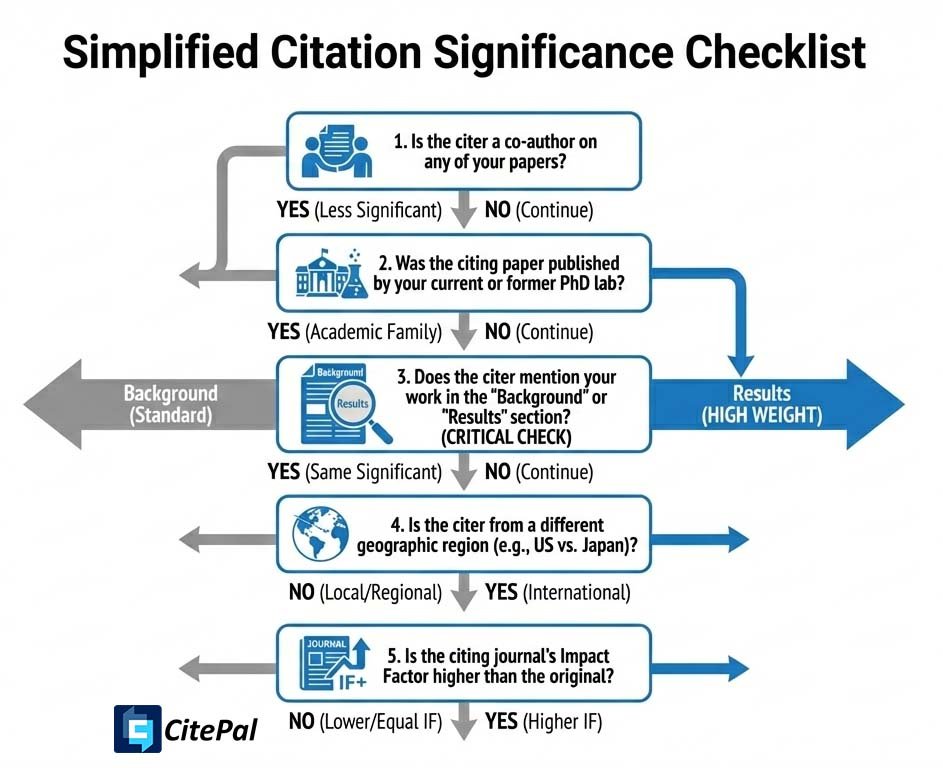
Co-Authors: Anyone who has listed you as a co-author on any paper, past or present.
Advisors and Mentees: Your thesis supervisors, Ph.D. advisors, or students you are currently supervising.
Close Colleagues: Researchers in your immediate department or lab group who collaborate with you frequently.
The USCIS Perspective: Adjudicators view dependent citations with skepticism because they lack objectivity. If your former thesis advisor cites your work, it is expected; they are intimately familiar with your research and have a vested interest in your success. Therefore, dependent citations are often seen as a reflection of your personal network rather than your national or international acclaim.
2. Independent Citations: The "Gold Standard"
Independent citations are references to your work by researchers who have no personal or professional relationship with you. These authors have likely never met you, never collaborated with you, and do not work at your institution. They found your work solely through the merit of its publication and used it to advance their own research.
Who counts as an "Independent" citer?
Researchers at other institutions: A scientist at Oxford University citing your work while you are at MIT.
Researchers in other countries: A citation from a laboratory in Japan or Germany when you are based in the U.S.
Strangers in your field: Authors you have never met, spoken to, or emailed.
The USCIS Perspective: For an EB-1 petition, independent citations are the ultimate proof of "Original Contributions of Major Significance." They demonstrate that your influence has crossed institutional and geographic borders. When a researcher in a different country, whom you have never met, cites your findings to solve a problem in their own lab, it proves that your work is driving the field forward independently of your personal presence. This is exactly the definition of "sustained national or international acclaim." This table shows some examples of dependent versus independent citations:
| Feature | Dependent Citations | Independent Citations |
|---|---|---|
| Relationship | Authors have a direct personal or professional connection to you. | Authors have no personal or professional relationship with you. |
| USCIS Weight | Lower weight; viewed as "internal" validation from your network. | High weight; proof of "Original Contributions of Major Significance." |
| Primary Example | Self-Citation: You cite your own previous work in a new paper. | External Peer: A researcher you've never met cites your work for their own study. |
| Network Example | Co-Authors/Advisors: Citations from anyone you have collaborated with or worked under. | Global Scope: Citations from different institutions or countries (e.g., NASA citing your MIT research). |
| Adjudicator View | May be subtracted from total counts to determine "true" impact. | Viewed as the "Gold Standard" for sustained international acclaim. |
2026 USCIS Policy Updates: Impact on Citation Analysis
USCIS has shifted from a simple "box-ticking" or "counting" approach to a more rigorous, two-step evaluation known as the Final Merits Determination, based on the Kazarian USCIS standard. This process requires that, after meeting at least three out of ten initial criteria (read more about these criteria in our post related to EB-1 eligibility), an applicant's entire body of evidence must be assessed in its entirety to determine if they truly belong to the small percentage at the very top of their field.
Under this heightened scrutiny, the role of citations has evolved from merely proving "authorship" to becoming the cornerstone for proving the "significance" of a contribution:
Moving Beyond "Authorship" (Criterion 6): Simply publishing scholarly articles—regardless of the journal's prestige—is often seen as just meeting the technical requirement for authorship. On its own, it may not prove extraordinary ability in the Final Merits stage.
Defining "Original Contributions of Major Significance" (Criterion 5): Independent citations are now the primary objective evidence used to satisfy this more difficult criterion. USCIS looks for demonstrable adoption or influence, where your work has fundamentally changed or advanced the field.
The Power of Independent Citations: While self-citations are often discounted, independent citations from reputable, unrelated sources serve as a "proxy" for acclaim. They prove that others in the field are not just aware of your work but are actively building upon or implementing it.
In the current adjudicatory environment, a high citation count—specifically when analyzed qualitatively to show how the work was used—is often the most persuasive way to bridge the gap between "having a job in the field" and "being a leader of major significance".
As a reminder, to qualify for an EB-1A Extraordinary Ability green card without a one-time major achievement (like a Nobel Prize), you must provide evidence satisfying at least three of the following ten criteria established by USCIS:
Nationally or Internationally Recognized Awards
Membership in Distinguished Associations
Published Material About You
Judging the Work of Others
Original Contributions of Major Significance
Authorship of Scholarly Articles
Artistic Exhibitions or Showcases
Leading or Critical Role
High Salary or Remuneration
Commercial Success in Performing Arts
How Self-Citation Can Negatively Impact Your EB-1 Application
One of the most common pitfalls in EB-1 petitions is "citation inflation" through excessive self-citation. While citing your own relevant past work is standard academic practice, USCIS officers are trained to spot when this is used to manipulate data.
1. The "Inflation" Red Flag
If you have 200 total citations, but 50 of them are self-citations, your "effective" impact is significantly lower in the eyes of the officer. An adjudicator may issue a Request for Evidence (RFE) during your EB-1 petition, demanding that you recalculate your citation count, excluding all self-citations. If the remaining number is low, your case for "extraordinary ability" creates a vacuum.
2. The "Provincial" Argument
High rates of self-citation (or citations by your own lab group) allow USCIS to argue that your work is "provincial"—meaning it is only relevant to you and your immediate collaborators, not the field as a whole.
3. The Calculation Risk
Immigration officers often use tools like Web of Science or Scopus, which have built-in filters to "exclude self-citations." Please make sure to check your citation counts on different platforms, as their citation indexing times are significantly different. If your petition claims 500 citations but the officer's search reveals only 300 independent ones, you lose credibility. It is far better to be transparent from the start.
How Many Independent Citations Do I need for EB-1A?
USCIS does not set a single "magic number" of citations for EB-1A. Instead, adjudicators are instructed to evaluate your citation record relative to the norms of your specific field. Under the Final Merits Determination, a citation count is only considered "extraordinary" if it places you in the small percentage at the top of your specific field. Citation patterns vary dramatically based on the size of the research community and the speed of the publication cycle.
| Field Type | Field Examples | Typical "Strong" Benchmark | Why? |
|---|---|---|---|
| High-Volume | Molecular Biology, Medicine, Physics | 500 – 1,000+ | Large research teams and frequent cross-referencing. |
| Mid-Range | Chemistry, Engineering, Economics | 150 – 400 | Moderate publication speed and community size. |
| Low-Volume | Pure Mathematics, Philosophy, Humanities | 20 – 100 | Smaller, highly specialized communities where 50 citations can be more impactful than 500 in biology. |
| Applied/Creative | Business, Arts, Technology | N/A | Success is measured by patents, market adoption, or exhibitions rather than academic citations. |
Some important remarks on citation for EB-1A:
a) Your petition should include "Field-Normalized" data (e.g., from Scopus or Web of Science) to show that your 100 citations actually place you in the top 1% of your niche.
b) USCIS increasingly values who is citing you. A few dozen citations from government agencies or industry leaders often carry more weight than hundreds from unknown sources.
c) Adjudicators heavily discount self-citations. A high total count can actually trigger an RFE if more than 30% are self-citations.
An Example for Your EB-1 Petition:
A strong EB-1 petition often includes a "Citation Analysis Report" where you proactively filter your data. You might say:
"Dr. [Your Name Here] has a total of 500 citations. Notably, 450 of these are independent citations from researchers at leading institutions such as Harvard, NASA, and CERN, demonstrating broad international reliance on their work."
This approach turns a potential weakness into a verified strength.
Summary and how CitePal can help your EB-1 petition
Ultimately, securing approval for your EB-1 self-petition requires more than just a high total citation count; it requires proof of genuine international influence. USCIS officers are trained to look past the surface, and nothing undermines a claim of "extraordinary ability" faster than a record inflated by excessive self-citation.
To build a bulletproof case, you must proactively audit your own research impact. We recommend looking at a specific self-citation example—such as a paper cited primarily by your own co-authors—to understand what an officer might discount. Before you submit, use a reliable self-citation calculator or a manual self-citation checker to filter out these internal references.
By presenting a transparent, high-quality record that accurately reflects self-citation EB-1 standards, you shift the focus to your strongest asset: your independent, global acclaim.
CitePal can efficiently help you with your EB-1 petition by providing a professional “citation analysis report” to assess the self-citation status that you will need during your application. You can browse our services here.
❓ Frequently Asked Questions about Self-Citation and EB-1 Visa
Does USCIS completely ignore dependent or self-citations?
While USCIS does not necessarily "ignore" them, they carry significantly less weight. Adjudicators often subtract self-citations and citations from co-authors to determine your "true" impact on the field. A high number of dependent citations may be viewed as a reflection of your professional network rather than your international acclaim.
Is a citation from a former colleague or student considered independent?
Generally, no. USCIS typically classifies citations from anyone with a direct personal or professional connection—such as former advisors, students, or long-term collaborators—as dependent. For a citation to be truly "independent," the author should ideally have no prior working relationship with you.
Why is an "Independent Citation Analysis" important for my EB-1 petition?
A proactive analysis allows you to present a transparent and credible case. By filtering out self-citations and highlighting the global reach of independent researchers citing your work, you prove to the officer that your research is being utilized purely for its merit, which is a key requirement for demonstrating "extraordinary ability."
Can too many self-citations lead to a Request for Evidence (RFE)?
Yes. If a significant portion of your total citation count is comprised of self-citations, USCIS may issue an RFE questioning the "major significance" of your contributions. They may argue that your work is "provincial" or only relevant to your own immediate research group rather than the broader scientific community.
How can I efficiently track and prove the independence of my citations?
You can use tools like Scopus or Web of Science to filter results, but a manual "citation audit" is often necessary for accuracy. Services like CitePal provide professional citation analysis reports that specifically verify independent impact and help you present this data clearly to USCIS, saving you time and reducing the risk of an RFE.
Written by the CitePal Editorial Team, specializing in academic metrics and USCIS citation standards for EB-1A, EB-1B, NIW petitions, and citation boosting services. Our data is derived from 500+ successful applicant profiles.